The first pattern for the proposed new rupee was submitted
to the Mint Committee on
|
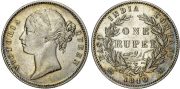
Bust of the King facing right. Surrounded by the
legend: G All within a
raised, toothed rim. |
The value in English: RUPEE 1834
All within a
raised, toothed rim. |
|
Official
Weight (g) |
- |
|
Actual
Weight (g) |
Varies. See table below |
|
Actual
Diameter (mm) |
26.4-26.6 |
|
Composition |
Silver |
|
Edge |
Varies. See table below |
|
Axes |
↑↓ |
|
Cat No. Brt- |
Pr. No. |
Date
|
Mint/ Mintmark |
Status |
Edge |
Weight (g)
|
Comments
|
Rarity |
Value (£) |
|
1918. |
168 |
1834 |
No MM |
Pattern |
SG |
11.59-11.64 |
|
RR |
1500 |
|
1919. |
169 |
” |
Calcutta
No MM |
Pattern |
P |
6.25 |
Struck on a thin flan |
RRR |
NV |
[1] Bengal Consultations. IOR P/162/49, 5th May
1834, No1.
From Calcutta Mint Committee to Government, dated 15th
April 1834.
In the letter which we had the honor to address to
your honor in Council on 8th February, on the subject of the dies
prepared at the Calcutta mint for the Bombay new copper currency, we stated
that we had acceded to a proposition made to us by the Assay Master that
Kasinath, the engraver, should be allowed to try his skill in engraving on
steel a master die of His Majesty’s head as a specimen of the capabilities of a
native artist to conduct this important branch of the mint processes, should it
be determined to effect a reform of the device of our Indian coin and to
substitute a pictorial representation for the present Persian inscription.
Mr James Prinsep has now laid before us the
accompanying specimen coin, the obverse and reverse of which have both been
executed by Kasinath. From some unfortunate imperfection in the steel, the die
of the King’s head cracked in the process of hardening, for which of course the
engraver is not answerable. This accident has not only injured the appearance
of the device, but has prevented the possibility of polishing the face of the
die. Nevertheless the design is not so far disfigured as to prevent a tolerable
judgement being formed of the style of Kasinath’s execution, and the fidelity
of his copy from the English sovereign given as a master.
We have sanctioned the payment of 400 rupees, the sum
previously stipulated, as a remuneration to Kasinath for the labour of
executing the two dies.
Mr Prinsep founds several propositions upon the
result of this experiment, which have been set forth at such length in the
notes submitted by him to our Committee that, considering the Government to be
already in possession of our sentiments on most of the questions embraced, we
think it unnecessary to trouble your Honor in Council with more than a brief
recapitulation of the important points which we are desirous of once more
bringing under the deliberation of the Supreme Government.
We think that the present experiment has fully
established the competency of a native die engraver to execute the reform of
the dies, whereas hitherto it has been assumed to be indispensable to defer any
attempt to effect this object until an European artist should be obtained from
England.
We recommend the appointment of Kasinath as head die
engraver on a suitable salary and with such assistance as may be found
necessary in order that he may prepare matrices of various dies for the approval
of Government…..
[2] Bengal Consultations. IOR P/162/83, 24th
May 1834, No 28
Letter from Calcutta Mint Committee to Saunders (Mint
Master), dated
I am directed by the Mint Committee to forward the
accompanying copy of a letter from the secretary to Government in the General
and Financial Department communicating the sanction of Government to the
payment of 400 rupees for the dies lately executed by Kasinath, which you are
accordingly authorized to disburse.
You will perceive also that you are permitted to
engage Kasinath as head engraver on a salary of 250 rupees per month with 50
rupees for workmen, tools and printing presses.
As soon as you may have arranged the accommodation of
the new engraver in the mint, the committee direct me to request that you will
set him to work in preparing matrices for the proposed reform of the coinage.
[3] Bengal Consultations. IOR P/162/49, 5th
May 1834. No 4
Note III from Prinsep, attached to a letter from the Calcutta Mint
Committee to Government, dated 15th April 1834.
…I have now the honor to submit the result of the experiment with equal
confidence that the artist’s labours will be found to merit the Committee’s
approbation.
The obverse of the model coin now presented is a facsimile of the King’s
head on the English sovereign with the legend Gulielmus IIII G.G. Britanniarum
Rex F.D. I could not procure a double
sovereign nor a half crown of His Present Majesty, either of which would have
been preferable in size for the die of the rupee.
The reverse consists of a wreath of laurel copied on a reduced scale
from a very beautiful model [medal?] die in the possession of Captain Forbes…